App preview
Inside TM9 2.0.
Live quotes, charts, portfolio and analysis tools on the phone.
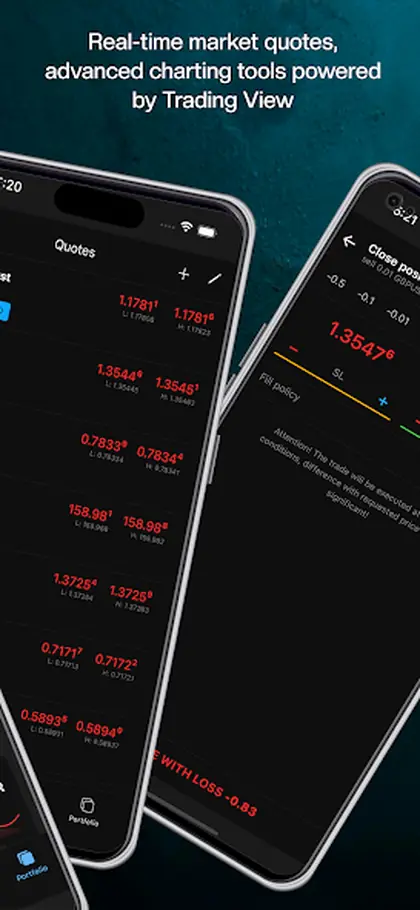
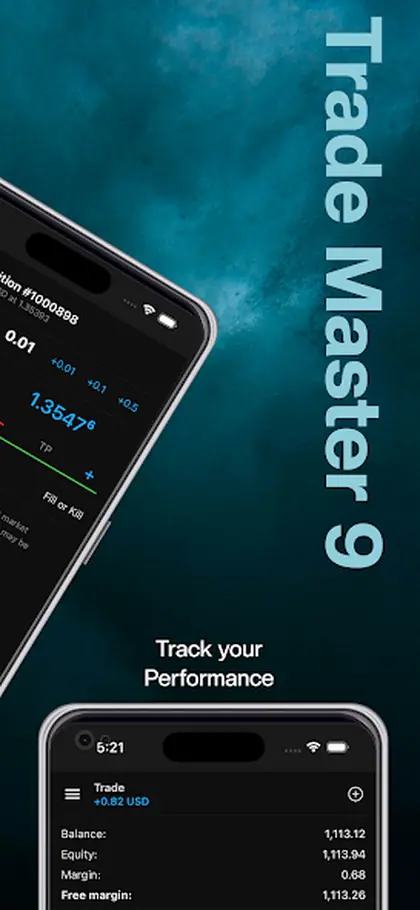
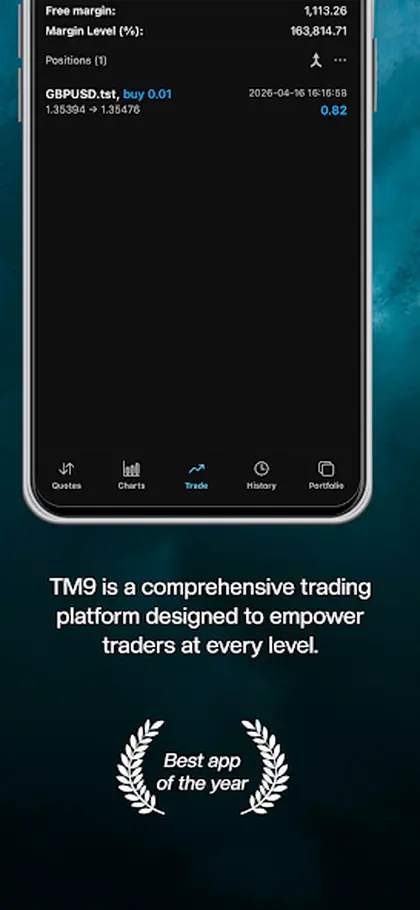
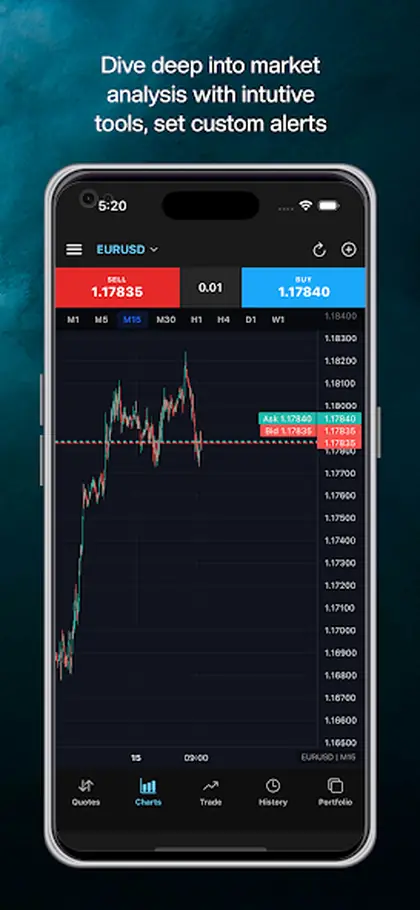
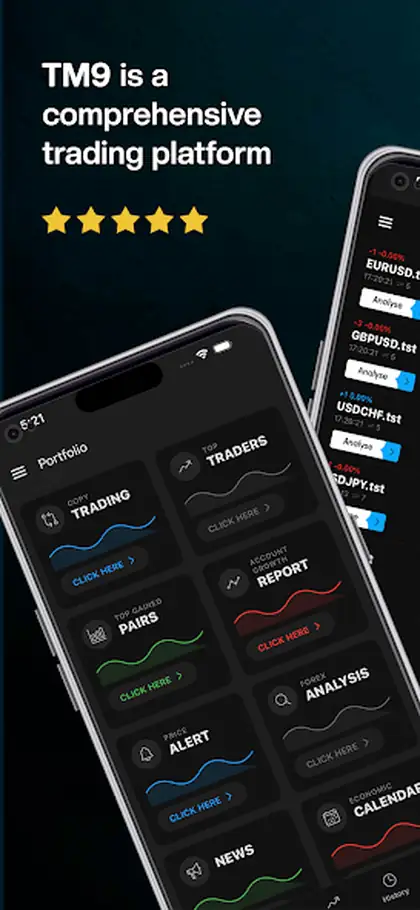
TM9 is a next-generation trading mobile app for operations in the Forex and exchange markets — and this is where to start if you are new.
Currency pairs, pips, spreads, leverage, orders and risk management, explained plainly, with a demo account to practise in before real money is involved.
Forex trading for beginners starts with understanding how the foreign exchange market works before attempting to trade with real money. A beginner should learn currency pairs, price quotes, pips, spreads, leverage, margin, order types, charts and risk management.
Trading software such as TM9 can provide charts, market data, order-management tools and other features, but software does not remove the financial risks of Forex trading.
Forex, short for foreign exchange, is the global market where currencies are exchanged.
Forex trading involves trading one currency against another. This is represented through a currency pair such as EUR/USD, where one currency is quoted in relation to another.
The Forex market is used by banks, financial institutions, corporations, governments, investors and individual traders for different purposes, including currency conversion, hedging and speculation.
Individual traders generally access Forex through a broker and trading platform rather than directly accessing the institutional interbank market.
Forex trading is based on the relative value of one currency compared with another.
Example: In the currency pair EUR/USD, EUR is the base currency and USD is the quote currency. The quoted price represents how many US dollars are required for one euro at that quoted rate.
If a trader buys EUR/USD, the position generally reflects an expectation that the euro will strengthen relative to the US dollar. If a trader sells EUR/USD, the position generally reflects an expectation that the euro will weaken relative to the US dollar.
Actual trading results depend on market movements, transaction costs, position size, leverage and other factors.
Currency pairs are the basic instruments used in Forex trading. Each pair contains two currencies.
| Category | Description | Examples |
|---|---|---|
| Major Pairs | Currency pairs involving major currencies and typically the US dollar. | EUR/USD, GBP/USD, USD/JPY, USD/CHF |
| Minor Pairs | Currency combinations that generally do not include the US dollar. | EUR/GBP, EUR/JPY, GBP/JPY |
| Exotic Pairs | Combinations involving a major currency and a less frequently traded currency. | USD/TRY, USD/ZAR, EUR/TRY |
Availability, liquidity, spreads and trading conditions vary by broker and currency pair.
A pip is a commonly used unit for describing a change in a Forex exchange rate.
For many currency pairs, a pip corresponds to the fourth decimal place. For currency pairs involving the Japanese yen, the commonly used pip position is generally the second decimal place.
Example: If EUR/USD moves from 1.1000 to 1.1010, the change is 10 pips under the conventional four-decimal quotation.
Some brokers quote currencies with fractional pip pricing, often called pipettes. Traders should check the quote format used by their broker.
Learn more in the dedicated Forex Pips Guide .
The spread is the difference between the bid price and ask price of a trading instrument.
Bid: The price at which the market or broker can buy the instrument according to the applicable quotation.
Ask: The price at which the market or broker can sell the instrument according to the applicable quotation.
The spread is one of the costs that traders should consider when evaluating a Forex trade.
Spreads can vary according to the currency pair, market conditions, liquidity, broker and account type.
See also: Forex Spread Guide .
Leverage allows traders to control a larger position relative to the amount of capital allocated to the trade.
Leverage can increase the market exposure available to a trader, but it also increases the potential impact of adverse price movements.
Important: Leverage does not make trading safer. A leveraged position can generate losses quickly when the market moves against the trader.
The maximum leverage available depends on the broker, jurisdiction, instrument, account type and applicable regulations.
Learn more: Forex Leverage Guide .
Margin is the amount of capital required to open or maintain a leveraged trading position.
Margin should not be confused with the total value of the market position. A leveraged position may have a much larger notional exposure than the margin allocated to it.
Traders should understand available margin, used margin, free margin and margin requirements before trading leveraged products.
See: Forex Margin Guide .
Lot size refers to the quantity or contract size associated with a Forex position.
Different brokers and trading environments can support different minimum and maximum trade sizes.
The actual contract specifications should always be checked with the broker before placing an order.
Learn more: Forex Lot Size Guide .
Charts help traders visualise how the price of a currency pair has changed over time.
Different timeframes provide different views of market behaviour. A short timeframe can show more immediate price fluctuations, while longer timeframes can provide broader market context.
Beginners should avoid assuming that one timeframe is universally better than another.
Explore: Forex Charting .
Technical analysis uses historical and current market data to study price behaviour.
Studying whether price is generally moving upward, downward or sideways.
A price area where buying interest may have appeared historically.
A price area where selling pressure may have appeared historically.
Examining the strength and speed of price movement.
Examining how significantly market prices are moving over time.
Mathematical calculations applied to price or volume data to support market analysis.
Technical indicators are analytical tools, not guarantees of future price movements.
Fundamental analysis examines economic and financial information that can influence currency values.
Fundamental information can affect currency markets, but market reactions are not always predictable.
An order is an instruction to buy or sell a financial instrument according to specified conditions.
| Order Type | General Meaning |
|---|---|
| Market Order | An instruction to buy or sell at the available market price, subject to execution conditions. |
| Limit Order | An instruction to trade at a specified price or better according to the order conditions. |
| Stop Order | An instruction that becomes active when a specified price condition is reached. |
| Stop-Loss | A risk-management instruction designed to limit losses according to specified conditions. |
| Take-Profit | An instruction intended to close a position when a specified profit condition is reached. |
Order availability and execution behaviour vary by broker and trading environment.
Learn more: Forex Orders Guide .
A stop-loss is a trading instruction designed to close a position when a specified price condition is reached.
Traders may use stop-loss orders as part of a predefined risk-management plan.
A stop-loss does not guarantee that the final execution price will always be exactly the specified level. Market gaps, volatility, liquidity and execution conditions can affect the actual result.
See: Stop-Loss Guide .
A take-profit instruction is designed to close a position when a specified price condition is reached.
Traders may use take-profit orders as part of a predefined trading plan.
Like other orders, execution depends on market conditions and the broker's execution rules.
Learn more: Take-Profit Guide .
Risk management is one of the most important areas for a new Forex trader to understand.
A trading strategy can generate losing trades. Risk management is intended to control the impact of those losses on trading capital.
Beginner principle: Do not increase position size simply because a previous trade resulted in a loss. Trading decisions should follow a predefined risk-management process rather than an attempt to recover losses quickly.
See: Forex Risk Management .
A demo account provides a simulated environment where beginners can learn trading software and practise market mechanics without immediately using real trading capital.
Demo trading is useful for learning the platform, but simulated trading does not guarantee that results will be the same in a live account.
A trading platform brings market information and trading tools together in one software environment.
TM9 provides trading environments across web, desktop and mobile. Supported functionality includes market information, charts, technical analysis, alerts, order management, copy trading and automated trading tools.
Beginners should learn the platform interface before attempting complex strategies.
Explore: Forex Trading Platform and Forex Trading Software .
A Forex trading app can provide access to market information and trading functionality through smartphones and tablets.
Mobile access is useful for monitoring markets, checking positions and receiving alerts, while a larger desktop or web interface may be more convenient for detailed chart analysis.
See: Forex Trading App and Mobile Forex Trading .
Understand currency pairs, pips, spreads, leverage, margin and lot sizes.
Select software that provides the charts, order tools and device access you require.
Review the broker's regulatory information, account terms, costs, available markets and execution conditions.
Use a demo environment where available to practise the platform and trading process.
Study price charts and understand the technical tools you plan to use.
Understand market, limit, stop and other supported order types.
Define position size, maximum loss and other risk controls before live trading.
Keep records of trades and review decisions rather than focusing only on individual outcomes.
Only consider using real capital after understanding the risks and the mechanics of the trading environment.
High leverage can increase market exposure and accelerate losses.
Entering trades without predefined entry, exit and risk conditions can make decision-making inconsistent.
Spreads, commissions and financing costs can affect trading results.
More trades do not automatically mean better results.
Increasing risk to recover previous losses can compound financial losses.
Technical indicators should be understood before being used as part of a trading process.
There is no single amount that applies to every Forex trader. Minimum deposits, minimum position sizes, margin requirements and account conditions vary between brokers and jurisdictions.
The more important beginner question is whether the trader understands the potential loss associated with the position size and leverage being used.
A small deposit does not automatically mean small risk. Leverage can create significant market exposure relative to account capital.
Beginners should review the broker's current account requirements and risk disclosures before depositing money.
Forex trading can involve several different costs.
| Cost | Meaning |
|---|---|
| Spread | Difference between the bid and ask price. |
| Commission | A trading charge that may apply to certain account structures. |
| Financing | Charges or credits associated with holding certain positions overnight. |
| Deposit Fees | Fees that may apply to certain funding methods. |
| Withdrawal Fees | Fees that may apply to certain withdrawal methods. |
Actual costs vary by broker, instrument, account type and market conditions.
Trading decisions are not based only on charts and market data. Discipline and emotional control can also affect how a trader follows a predefined strategy.
Online Forex trading allows beginners to access trading software through web, desktop or mobile environments.
TM9 provides web, desktop and mobile trading environments, allowing users to access supported market information, charts and trading functionality through different devices.
Explore: Online Forex Trading .
Mobile Forex trading can be convenient for monitoring markets, checking alerts and managing supported positions.
However, beginners should avoid confusing convenience with lower risk. A mobile application provides access to the market but does not change the underlying risk of Forex trading.
Learn more: Mobile Forex Trading .
| Learning Stage | Recommended Topic |
|---|---|
| 1 | What Is Forex? |
| 2 | Forex Pips |
| 3 | Forex Spread |
| 4 | Forex Leverage |
| 5 | Forex Margin |
| 6 | Forex Lot Size |
| 7 | Forex Orders |
| 8 | Stop-Loss |
| 9 | Take-Profit |
| 10 | Risk Management |
| 11 | Position Sizing |
| 12 | Trading Psychology |
Forex trading involves buying one currency and selling another through a currency pair such as EUR/USD.
Yes. Beginners can learn currency pairs, pips, spreads, leverage, margin, charts, orders and risk management before considering live trading.
A currency pair represents the exchange relationship between two currencies. The first is the base currency and the second is the quote currency.
A pip is a commonly used unit for expressing changes in Forex exchange rates. The exact decimal convention depends on the currency pair and quotation.
The spread is the difference between the bid and ask price of a financial instrument.
Leverage allows traders to control a larger market position relative to allocated capital. It can increase both potential gains and potential losses.
Margin is the capital required to open or maintain a leveraged position according to the broker's requirements.
A demo account can help beginners learn trading software, practise order types and understand market mechanics without immediately risking real capital.
There is no universal amount. Minimum deposits, margin requirements and minimum trade sizes depend on the broker, account and jurisdiction.
Yes. Forex trading involves significant financial risk.
No. TM9 is trading software and a platform provider. The connected broker provides the trading account and handles client funds and applicable trading conditions.
Start with the fundamentals, learn how trading platforms work, practise with a demo environment where available and understand risk management before considering live Forex trading.
Forex and other financial-market trading involve substantial risk and may result in the loss of capital. Past performance does not guarantee future results.
Leverage can increase both potential gains and potential losses. Technical indicators, trading signals, automated strategies, trading robots and copy-trading tools are not guarantees of profit.
TM9 is trading software and a platform provider, not a broker. Trading conditions, spreads, leverage, commissions, execution and account terms are determined by the applicable broker. Review the broker's regulatory status, terms and risk disclosures before depositing funds or trading.
Live quotes, charts, portfolio and analysis tools on the phone.
Eight pages covering the market, the app, the platform and the software behind it.
The market itself, and how TM9 helps you analyse it.
The app across Android, iPhone, web and desktop.
How to judge a forex app before you commit.
The multi-asset platform behind the app.
Software for mobile, web and desktop.
Trading online from any device you sign in on.
Charts, alerts and orders from your phone.
Start from the home page, or browse every guide in the TM9 Guides and Platform Guide hubs.
forex-trading-mobile-app-android-download.html
forex-trading-mobile-app-android-free-download.html
forex-trading-mobile-app-android-free.html
Or jump to the TM9 Guides and Platform Guide hubs, or the home page.