App preview
Inside TM9 2.0.
Live quotes, charts, portfolio and analysis tools on the phone.
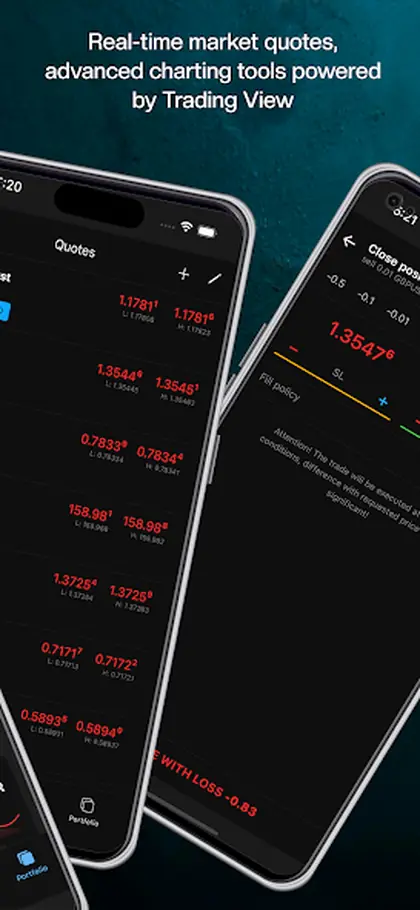
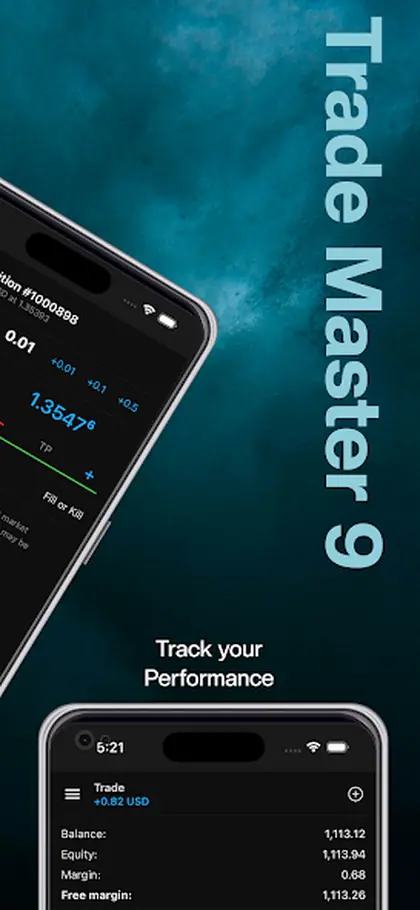
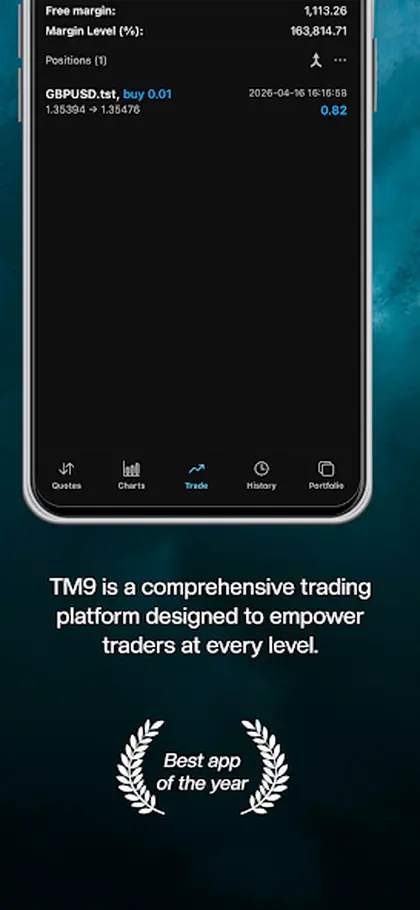
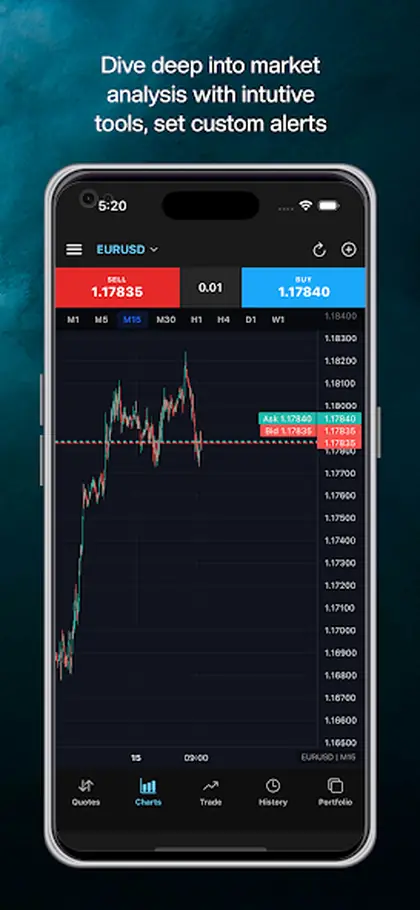
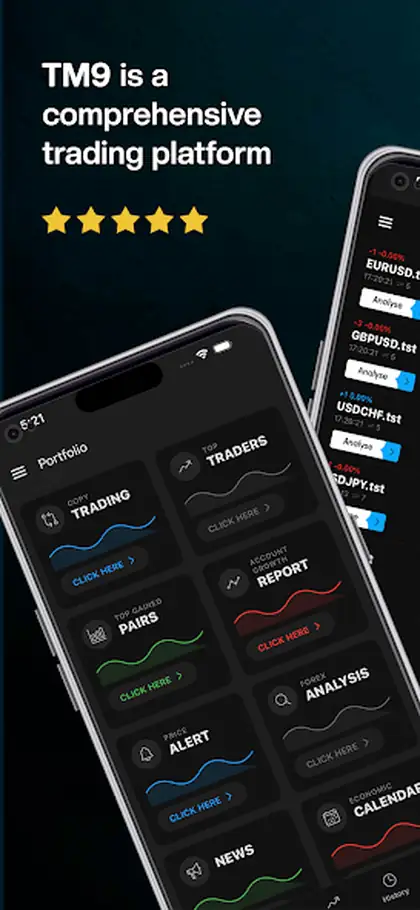
TM9 is a next-generation trading mobile app for operations in the Forex and exchange markets — this page covers the market those operations run in.
Currency pairs, participants, sessions, liquidity, volatility, economic events, analysis and access — the eight things worth understanding before you trade.
The Forex market, also known as the foreign exchange market or FX market, is the global marketplace for exchanging currencies.
Unlike a single physical exchange, Forex trading takes place through a global network of financial institutions, liquidity providers, brokers and other market participants. Individual traders normally access Forex through a broker-connected trading platform.
TM9 provides trading software that connects traders to supported brokers and provides market data, charts and trading tools across supported environments.
Forex stands for foreign exchange. The Forex market is where one currency is exchanged for another.
Currency values are represented through currency pairs. For example, EUR/USD represents the relationship between the euro and the US dollar.
Base Currency: The first currency in a currency pair.
Quote Currency: The second currency in a currency pair.
Exchange Rate: The quoted value represents how much of the quote currency is required for one unit of the base currency.
Forex prices change continuously during active market periods as supply, demand, economic information, interest-rate expectations, market sentiment and other factors change.
Forex trading is based on the relative value of two currencies. When a trader buys a currency pair, the position represents an expectation about the relative movement of the base currency against the quote currency.
When a trader sells a currency pair, the position generally represents the opposite market view.
Suppose EUR/USD is quoted at 1.1000. This means one euro is quoted at 1.1000 US dollars at that particular market price.
If the quoted price rises, the euro has increased in value relative to the US dollar at that quoted rate. If the quoted price falls, the euro has decreased relative to the US dollar.
A trader's actual result also depends on entry and exit prices, position size, spread, commission, financing and execution.
The Forex ecosystem contains many different types of participants.
Central banks influence currency markets through monetary policy, interest rates, foreign-exchange operations and communication.
Banks facilitate currency transactions for customers and participate in financial markets.
International companies may exchange currencies to support international business operations and manage currency exposure.
Investment managers and financial institutions may trade currencies as part of portfolio or risk-management activities.
Brokers provide trading accounts and access to financial markets according to their business model and regulatory framework.
Retail traders use broker-connected trading platforms to analyse markets and place supported orders.
Currency pairs are the primary instruments used to represent Forex prices.
| Category | General Description | Examples |
|---|---|---|
| Major Currency Pairs | Major currencies paired with the US dollar. | EUR/USD, GBP/USD, USD/JPY, USD/CHF, AUD/USD, USD/CAD, NZD/USD |
| Minor Currency Pairs | Major currencies paired with each other without directly including USD. | EUR/GBP, EUR/JPY, GBP/JPY |
| Exotic Currency Pairs | A major currency paired with a less frequently traded currency. | USD/TRY, USD/ZAR, EUR/TRY |
Spreads, liquidity, volatility and availability can vary significantly between currency pairs and brokers.
Learn more: Forex Currency Pairs .
Major currency pairs are commonly traded Forex pairs involving the US dollar and another major currency.
| Pair | Currencies | General Market Context |
|---|---|---|
| EUR/USD | Euro / US Dollar | Eurozone and US economic conditions. |
| GBP/USD | British Pound / US Dollar | UK and US economic conditions. |
| USD/JPY | US Dollar / Japanese Yen | US and Japanese monetary and economic conditions. |
| USD/CHF | US Dollar / Swiss Franc | US and Swiss economic conditions. |
| AUD/USD | Australian Dollar / US Dollar | Australian and US economic conditions. |
| USD/CAD | US Dollar / Canadian Dollar | US and Canadian economic conditions. |
| NZD/USD | New Zealand Dollar / US Dollar | New Zealand and US economic conditions. |
Forex market activity is commonly described through regional sessions associated with major financial centres.
The Asian trading period includes major financial centres such as Tokyo, Sydney and other regional markets. Activity and liquidity can vary significantly depending on the currency pair.
The European trading period is an important period for global currency activity, with London being one of the major global financial centres.
The North American trading period brings activity from the US and surrounding financial markets.
Session times vary with daylight-saving changes and local time conventions. Traders should check their broker's current market schedule rather than relying on a fixed UTC conversion.
When major regional trading centres are simultaneously active, market activity can change.
For example, periods when European and North American markets are both active can provide significant participation in many major currency pairs.
However, higher activity does not automatically mean lower risk. Increased activity can also accompany rapid price movements and changing spreads.
Forex is commonly described as a market operating around the clock during the global business week because trading activity moves between international financial centres.
However, this does not mean every currency pair or broker is continuously available every minute.
Brokers may have daily breaks, weekend closures, holiday schedules and instrument-specific trading hours.
Important: Always check the trading schedule provided by your broker for the specific instrument you want to trade.
Liquidity refers broadly to the availability of buyers and sellers and the ability to execute transactions without causing a large price impact.
Liquidity can change quickly. A currency pair that normally has active trading conditions may experience different conditions during major economic events or unusual market periods.
Volatility describes the magnitude and speed of price movements.
Forex volatility can increase around important economic releases, central-bank decisions, geopolitical developments and unexpected market events.
Price movements may be relatively limited during a particular period.
Prices move within ranges that may be consistent with recent market conditions.
Prices may move rapidly and spreads or execution conditions can change.
Traders should consider volatility when selecting position size, stop-loss distance and trading strategy.
Currency prices can respond to many interacting factors.
| Factor | Possible Market Relevance |
|---|---|
| Interest Rates | Changes in interest-rate expectations can influence currency valuations and capital flows. |
| Inflation | Inflation data can influence monetary-policy expectations. |
| Employment Data | Employment conditions can influence expectations about economic growth and monetary policy. |
| GDP and Economic Growth | Economic growth data can affect market expectations about an economy. |
| Central-Bank Communication | Statements and policy guidance can change market expectations. |
| Geopolitical Events | Political developments and geopolitical risks can affect market sentiment and currency demand. |
| Market Sentiment | Investor positioning and risk appetite can influence currency flows. |
Economic calendars are widely used by Forex traders to identify scheduled events that may affect currencies.
An economic release can cause rapid price movements, especially when the published result differs significantly from market expectations.
Explore: Forex Economic Calendar .
Technical analysis uses market price and related data to study trends, momentum, volatility and price structure.
Visualise historical and current price behaviour across different timeframes.
Identify areas where price has previously encountered buying or selling pressure.
Study whether the market is moving upward, downward or sideways.
Examine the strength and speed of price movement.
Study the size and frequency of market price movements.
Apply mathematical calculations to price or other market data as part of analysis.
Technical analysis provides information for decision-making but cannot guarantee future market direction.
See: Forex Technical Analysis .
Fundamental analysis examines economic, financial and political information that can influence currency values.
Traders may compare economic conditions between countries or regions represented by a currency pair.
For example, monetary-policy expectations in the United States and Eurozone can influence market expectations for EUR/USD.
Fundamental analysis does not provide certainty about future price movements. Market prices incorporate expectations, and actual reactions can differ from forecasts.
Explore: Fundamental Analysis .
Trading platforms generally display bid and ask prices for supported instruments.
Bid Price: The price associated with selling the instrument according to the applicable market quotation.
Ask Price: The price associated with buying the instrument according to the applicable market quotation.
Spread: The difference between the bid and ask prices.
Spreads can vary according to the instrument, broker, account type, liquidity and market conditions.
Leverage allows traders to control a larger market position relative to the capital allocated to the position.
While leverage can increase market exposure, it also increases the potential impact of adverse price movements.
Risk: Leverage can magnify losses as well as gains. Traders should understand their broker's leverage and margin requirements before trading.
Learn more: Forex Leverage Guide .
Traders use different order types to interact with the market.
| Order | General Purpose |
|---|---|
| Market Order | Requests execution at the available market price, subject to execution conditions. |
| Limit Order | Requests execution at a specified price or better according to applicable conditions. |
| Stop Order | Becomes active after a specified price condition is reached. |
| Stop-Loss | Used as part of a risk-management plan to limit potential losses. |
| Take-Profit | Used to define a planned position exit at a specified price condition. |
Available order types and execution methods depend on the broker, instrument and trading environment.
See: Forex Orders Guide .
Liquidity and spreads are closely related to the trading conditions experienced by traders.
Highly active markets can sometimes provide tighter spreads, while less liquid periods may produce wider spreads. However, this is not a fixed rule and conditions can change rapidly.
Around major economic events, both liquidity and spreads can behave differently from normal market conditions.
Traders should check actual broker quotations rather than assuming a particular spread.
Trading activity varies across currency pairs and time periods. Major currency pairs generally attract substantial global participation, while some less frequently traded pairs can have different liquidity characteristics.
Forex is a decentralised market, meaning there is not one central exchange that records all global Forex transactions.
Therefore, data displayed by a particular broker or platform can depend on its liquidity sources and market-data arrangements.
Market Depth can provide additional information about available orders around a current market price where the broker and trading venue supply depth data.
TM9 currently supports an advanced Market Depth feature, with the depth information supplied through the broker's market feed.
Market Depth should not be interpreted as a complete representation of all global Forex liquidity because Forex is decentralised and available depth depends on the relevant venue and feed.
TM9 combines market information, charts and analysis tools within its trading environments.
Current TM9 documentation describes technical indicators, price charts, analytical tools and fundamental market information for studying market conditions.
View available prices for supported financial instruments.
Study price movement across different timeframes.
Apply supported indicators to assist market analysis.
Review fundamental information relevant to market conditions.
Monitor selected market conditions through supported alerts.
Place and manage supported orders through a connected broker account.
TM9 is a trading software and platform provider rather than a broker. The platform connects to supported brokers, while the specific instruments and trading conditions available to a trader depend on the connected broker.
The current TM9 platform supports Forex alongside other asset classes such as stocks, futures, indices and commodities, subject to broker availability.
TM9: Trading software and platform.
Broker: Provides the trading account and applicable market access and trading conditions.
Trader: Makes the trading and risk-management decisions.
Traders can monitor supported Forex markets through different trading environments.
| Environment | Typical Use |
|---|---|
| Web Trading | Browser-based market analysis, charts, orders and account management. |
| Desktop Trading | Larger workspace for detailed chart analysis, trading and supported automation. |
| Mobile Trading | Market monitoring, alerts, charts and supported trading functions while using a smartphone. |
TM9 currently provides web, mobile and desktop environments, with account information and supported trading workflows available across the platform.
Explore: Online Forex Trading , Mobile Forex Trading and Forex Trading Platform .
Forex trading involves multiple sources of risk.
Risk management should therefore be considered before entering a position.
See: Forex Risk Management .
Beginners should first understand how the Forex market works before attempting to trade it.
Start with: Forex Trading for Beginners .
| Market | Primary Instrument | Important Considerations |
|---|---|---|
| Forex | Currency pairs. | Currency relationships, interest rates, economic data, liquidity and global sessions. |
| Stocks | Company shares. | Company financials, valuation, earnings and market conditions. |
| Futures | Standardised derivative contracts. | Contract specifications, expiry, margin and underlying market. |
| Commodities | Physical or derivative exposure to commodities. | Supply, demand, production, inventories and global economic conditions. |
| Indices | Market or sector benchmarks. | Underlying companies, economic conditions and market sentiment. |
TM9 currently presents Forex, stocks and futures within its multi-asset platform, with additional supported instruments depending on the connected broker.
A structured market-monitoring routine can help traders organise information before making decisions.
Review the currency pairs relevant to your trading plan.
Identify scheduled events that may influence currencies.
Consider whether current market movement matches your trading method.
Review price structure and relevant technical indicators.
Consider open positions before adding new market exposure.
Only consider a trade when the market conditions match your predefined rules.
The Forex market is the global marketplace where currencies are exchanged. Currency trading is normally represented through currency pairs such as EUR/USD.
Forex trading involves exchanging one currency against another. Traders normally access the market through brokers and broker-connected trading platforms.
Participants include central banks, commercial banks, corporations, investment firms, liquidity providers, brokers and individual traders.
Forex activity is commonly discussed using Asian, European and North American trading sessions. Exact hours vary according to local time, daylight-saving changes, broker schedules and instruments.
Forex activity moves across global financial centres during the business week, but exact trading hours, breaks and holiday schedules depend on the broker and instrument.
Currency prices can be influenced by interest rates, inflation, economic data, central-bank policy, geopolitical developments, market sentiment, liquidity and other factors.
Liquidity broadly refers to the availability of buyers and sellers and the ability to transact without causing a large price impact. Liquidity changes across instruments and market conditions.
Volatility describes the magnitude and speed of price movements. Forex volatility can increase around important economic events and unexpected market developments.
TM9 provides trading software that connects to supported brokers. Available Forex instruments and trading conditions depend on the connected broker.
No. TM9 is trading software and a platform provider. The connected broker provides the trading account and applicable trading conditions.
Study Forex prices, charts and market conditions through a broker-connected trading platform across supported web, desktop and mobile environments.
Forex trading involves substantial financial risk and may result in the loss of capital. Currency prices can move rapidly and market conditions can change without warning.
Leverage can increase both potential gains and potential losses. Spreads, liquidity and execution conditions can change during volatile markets, economic announcements and other events.
Technical analysis, fundamental analysis, indicators, alerts, signals, copy trading and automated trading tools do not guarantee trading profits.
TM9 is trading software and a platform provider, not a broker. The applicable broker determines account terms, spreads, leverage, execution, available instruments and other trading conditions. Review the broker's regulatory information and risk disclosures before depositing funds or trading.
Live quotes, charts, portfolio and analysis tools on the phone.
From currency pairs to market access — each one covered in its own guide.
Majors, minors and the instruments available through your broker.
Market ParticipantsBanks, funds, brokers and retail traders, and how they connect.
Market SessionsSydney, Tokyo, London and New York, and why overlaps matter.
LiquidityWhat Market Depth shows, and why liquidity moves your fill.
VolatilityVolatility alerts that reach you when a market starts moving.
Economic EventsScheduled releases, and deciding whether to hold through them.
Market AnalysisCharts, indicators and fundamentals for reading conditions.
Market AccessReaching the market from mobile, browser or desktop.
Nine pages covering the market, the app, the platform and the software behind it.
forex-trading.html
Forex Trading Appforex-trading-app.html
Best Forex Trading Appbest-forex-trading-app.html
Forex Trading Platformforex-trading-platform.html
Forex Trading Softwareforex-trading-software.html
Online Forex Tradingonline-forex-trading.html
Mobile Forex Tradingmobile-forex-trading.html
Forex Trading for Beginnersforex-trading-for-beginners.html
Browse everything in the TM9 Guides and Platform Guide hubs, or start at the home page.
forex-trading-app-download-android.html
Forex Trading App Mobile, Web & Desktopforex-trading-app.html
Forex Trading for Beginnersforex-trading-for-beginners.html
Or jump to the TM9 Guides and Platform Guide hubs, or the home page.